Malecón 2000 Guayaquil: The Riverfront Walk, Done Right (2026)
Here is the plan: Malecon 2000 Guayaquil works best walked south to north — start at the Palacio de Cristal, pause at La Rotonda, and finish with La Perla at dusk ($3.50) next to Las Peñas. Entry is free, security patrols the full 2.5 km from about 7am to midnight. The walk itself takes barely 40 minutes; it is the stops that stretch it into one to three good hours. It is the safest, easiest stretch of the city, and the one part of Guayaquil built for plain wandering.
Cuenca, the Volcanoes and the Galápagos: 14 Day Tour
Need to Know
- Cost: free entry; La Perla runs about $3.50, and food is the only other spend
- Hours: daily, roughly 7am to midnight, with gated entrances and security inside
- Time needed: the 2.5 km path takes about 40 minutes nonstop; with stops, budget 1 to 3 hours — a museum or the river cruise makes it a half-day
- Best moment: late afternoon into dusk — heat drops, lights come on, La Perla earns its ticket
- Getting there: Uber or Cabify to any gate; on foot it connects to Las Peñas and the iguana park
What Is Malecón 2000?
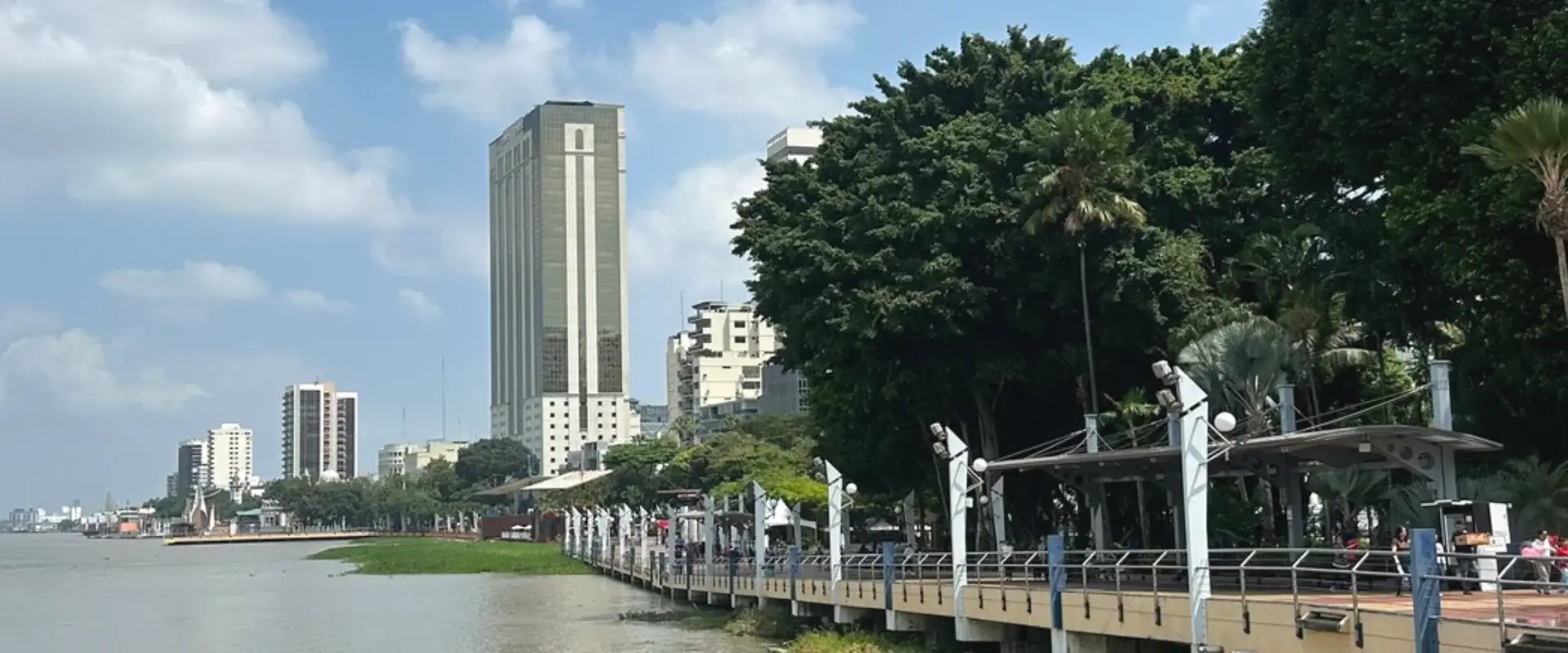
The Malecón is a 2.5 km riverfront promenade overlooking the Guayas River — the urban renewal project that changed the city of Guayaquil. Around the year 2000, the Fundación Malecón 2000 rebuilt the old Simón Bolívar waterfront into gardens, historical monuments, museums, playgrounds, and food halls, and the result is what made Malecon 2000 Ecuador’s postcard public space. It is genuinely one of the best urban waterfronts in South America, and locals use it as much as visitors do.
Malecón 2000 vs Malecón del Salado
Quick disambiguation, because taxi drivers get this wrong: Guayaquil has two malecones, run by the same foundation. Malecón 2000 (also called Malecón Simón Bolívar) is the riverfront promenade this guide covers. Malecón del Salado sits west of downtown on the Estero Salado — pleasant and very local, but it has none of the monuments, La Perla, or the Las Peñas connection. If you only have time for one, it is this one, on the river. Not sure where this fits in your itinerary? Send us your dates and we will sort the order out.
The Route: South to North, Stop by Stop
First, the timing reality: the path is only 2.5 km — about 40 minutes if you never stop. A quick pass with photos takes 45 minutes to an hour, the classic visit with monuments and La Perla runs about two, and a museum, lunch, or the river cruise turns it into a half-day. Walk it in this order and the malecón builds to its best finish:
- Palacio de Cristal — the restored iron-and-glass market hall at the south end; quick look, good photos
- Torre Morisca — the Moorish clock tower, the malecón’s oldest landmark
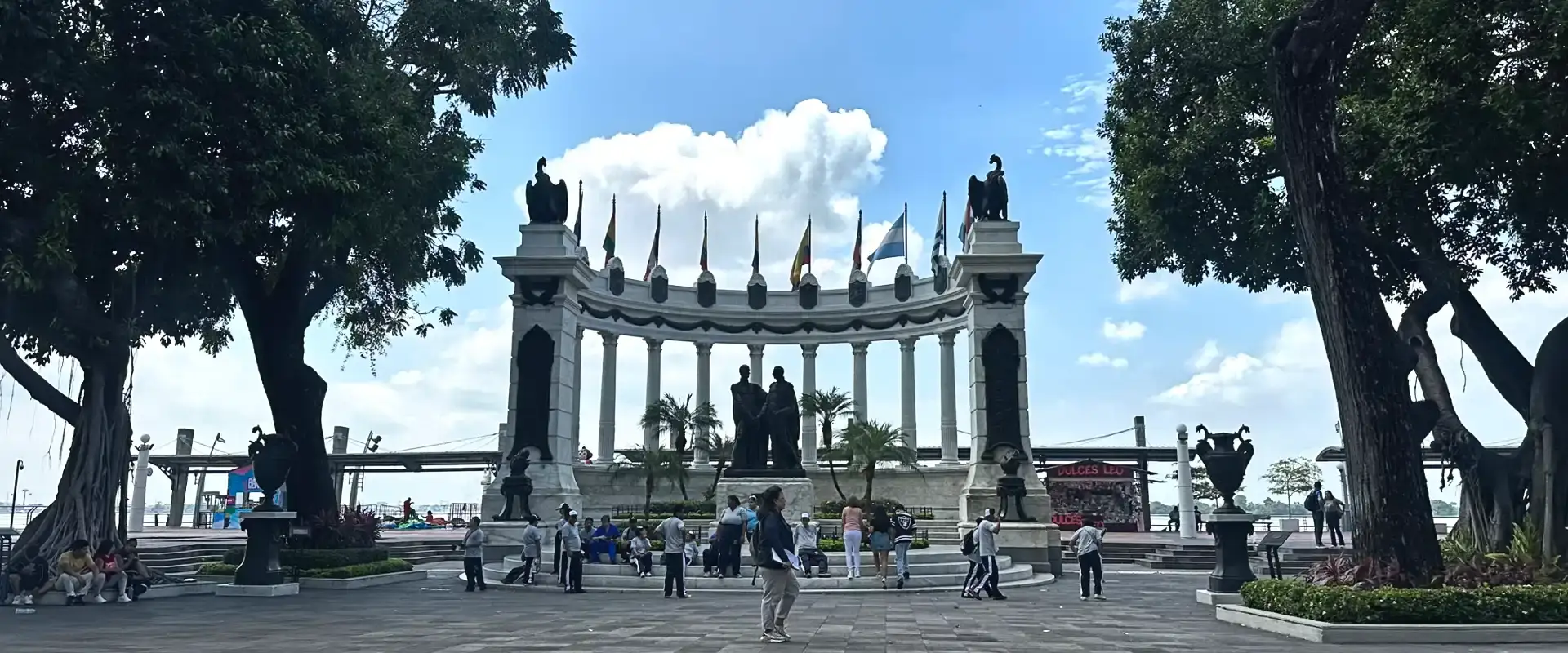
- La Rotonda — the monument where Bolívar met San Martín, right where Avenida 9 de Octubre hits the river; this is the postcard shot
- The gardens and museums — shaded botanical walkways, the IMAX dome, and the MAAC museum if you want air conditioning
- La Perla — one of South America’s biggest observation wheels, beside the GUAYAQUIL letters photo stop and the Safari Xtreme rides; save it for dusk
- North exit — you land at the base of Las Peñas, ready for the 444 steps if your legs agree
La Perla at Dusk
La Perla is the big Ferris wheel near the north end, and the $3.50 ride is the best cheap view in Guayaquil — if you time it. Go at dusk: the heat breaks, the river turns gold, and the city lights come on mid-rotation. Daytime rides are hotter and flatter. Lines are short on weekdays; weekends and holidays draw local families, which is its own kind of fun.
Where to Eat: Mercado del Río and Around
The Mercado del Río food hall near the north end is the easy answer: a dozen stalls under one roof where you can try encebollado or ceviche without gambling on a street corner. Prices run tourist-plus but portions are honest. For the wider food scene — bolón breakfasts, crab houses, and what to order where — see our Ecuadorian food guide.
TWO WEEKS, FULLY PLANNED
14 Day Ecuador and Galapagos Tour: Volcanoes, Cuenca and the Islands
Quito, Cotopaxi, Quilotoa, Chimborazo, Ingapirca and Cuenca, then a week on Santa Cruz and Isabela with a yacht day.
From $3,390 per person
View itineraryMore to Do: River Cruises, Museums, and Shopping
The walkway hides more than monuments. If you have extra time, these are the add-ons that actually earn it:
- Henry Morgan pirate ship — a replica pirate boat running Guayas River cruises from the malecón docks; the sunset departures are the ones worth planning around
- Guayaquil in History Miniature Museum — dioramas tracing the city from the 1500s to today; thirty entertaining minutes of air conditioning
- MAAC, planetarium, and the IMAX — the north end packs an anthropology-and-contemporary-art museum next to South America’s first IMAX dome
- Jardines del Malecón — 22,000 m² of native plants, ponds, and shade in the middle stretch
- Shopping — the Bahía Malecón center at the south end, plus the artisans’ plaza for handicrafts without the hard sell
- For kids — playgrounds, the lagoon, and the Safari Xtreme rides beside La Perla
Malecon 2000 Guayaquil Ecuador: Hours, Prices, and Rules
The practical block, in one place. Entry is free through any of the gated entrances, and the walkway runs daily from about 7am to midnight with security posted along the length — the official calendar of events and closures is on malecon2000.com. Bathrooms and ATMs live near the main gates, the path is stroller- and wheelchair-friendly, and shaded stretches alternate with open sun — carry water either way. One calendar note: around July 25 (the city’s founding) and October 9 (independence), the malecón hosts Guayaquil’s biggest public celebrations — great if you like a party, worth dodging if you do not.
Malecon 2000 Ecuador Facts at a Glance
- Length: 2.5 km along the Guayas River
- Opened: in stages around 2000, replacing the old Simón Bolívar waterfront
- Entry: free, daily, roughly 7am to midnight
- La Perla: about $3.50 per ride
- Anchors: Palacio de Cristal (south), La Rotonda (middle), La Perla and Las Peñas (north)
Is It Safe? The Honest Version
Inside the gates, yes — this is the most patrolled public space in Guayaquil, and by day you can relax more here than anywhere else in the city. The honest part: the streets AROUND the malecón get empty and edgy after dark, so at night, enjoy the walkway itself and take an app ride door to door when you leave — do not wander inland on foot. Phone discipline still applies in crowds. The full zone-by-zone reality is in our Is Guayaquil Safe? guide.
Build a Half-Day Around It
The malecón chains perfectly with its neighbors: the iguanas at Parque Seminario are a ten-minute walk inland, Las Peñas and the Cerro Santa Ana climb start right at the north exit, and the Aerovía cable car station sits nearby for skyline views over the river. That loop — iguanas, malecón, climb, dusk wheel — is the single best day in the city, and our things to do in Guayaquil guide sequences all of it. Flying to the islands tomorrow? The malecón is exactly how to spend the evening before — see the Guayaquil to Galapagos guide for the morning that follows.
Quick Answers
Is Malecon 2000 free to enter?
Yes. All the gated entrances are free, and the gardens, monuments, and river views cost nothing. The only money you might spend is La Perla (about $3.50), food, and the IMAX or MAAC museum if you go in.
What are the Malecon 2000 hours?
Daily from about 7am to midnight. Security patrols inside the gates for the full schedule. For special events and occasional closures, the official calendar at malecon2000.com has the current word.
How long does it take to walk Malecon 2000?
The path itself is 2.5 km — about 40 minutes end to end without stopping. Most visitors spend one to two hours with monument stops and photos; add La Perla, a museum, or the pirate-ship cruise and it becomes a comfortable half-day.
Is Malecon 2000 safe at night?
Inside the gates, yes — it is the most patrolled public space in Guayaquil and stays lively into the evening. The streets around it are a different story after dark: leave by app ride, door to door, and do not wander inland on foot.
Is Malecon 2000 suitable for families?
Very. Playgrounds, gardens, a Ferris wheel, museums with air conditioning, and a flat, stroller-friendly path make it the easiest family outing in the city. The iguana park ten minutes away seals the deal for kids.
How much is La Perla and when should I ride it?
About $3.50 per person. Ride it at dusk — the heat breaks, the Guayas River catches the last light, and the city lights come on during your rotation. Weekday evenings have the shortest lines.
What is Guayaquil famous for?
The Malecon 2000 riverfront, the free-roaming iguanas of Parque Seminario, the colorful Las Peñas neighborhood, crab feasts, and being the cheapest gateway to the Galapagos Islands. The malecon is where all of that meets the river.
Why is October 9 important for Guayaquil?
October 9, 1820 is Guayaquil’s independence day. Avenida 9 de Octubre carries the date, and it meets the river exactly at La Rotonda on the malecon — the monument where Bolívar and San Martín shook hands. That is why the spot is the postcard.
Do you need a guided tour for Malecon 2000?
No — the walkway is free, flat, and safe to self-guide with the route above. City tours that bundle it with Las Peñas and Parque Historico run about $78 to $95 per person on the big platforms; worth it only if you want a historian and hotel pickup in one organized morning.
Most travelers walk the malecón the night before an islands flight. If that is you, make the next leg count.
Before You Go
- Walk south to north, ending at La Perla and Las Peñas
- Go late afternoon; ride La Perla at dusk with $3.50 ready
- Eat at Mercado del Río instead of gambling elsewhere downtown
- App rides door to door after dark — the walkway is safe, the streets around it are not
- Pair it with the full Guayaquil day plan