Galapagos Islands History: Darwin, Evolution & Discovery
Add the Andes and the Amazon: 12 Day Ecuador & Galápagos Tour
History of the Galapagos Islands: Darwin, Evolution & Discovery
The Galápagos Islands have a 500-year human history that most visitors never learn. They were discovered by accident in 1535 (a Spanish bishop drifted off course), then used by pirates, then by whalers who killed over 100,000 tortoises between 1784–1860. Charles Darwin showed up for 5 weeks in 1835, and what he saw eventually became the theory of evolution. Today they’re a protected national park, with strict visit rules. Here’s the timeline that actually matters before you go.
The story starts with accident. Ends with revolution. And continues today with conservation that’s still working to protect what Darwin saw.

Who Discovered Galapagos Islands: A 1535 Accident
If you have been wondering who discovered galapagos islands, the answer is not Columbus or Darwin — it was Fray Tomás de Berlanga, a Spanish bishop blown off course in 1535. Nobody was looking for the Galapagos Islands. They kind of found themselves. The early Spanish explorers later named the archipelago “Galápagos” because the curved shells of the giant tortoises reminded them of a saddle — galápago in Spanish — giving the islands their permanent name.
In 1535, Spanish bishop Fray Tomás de Berlanga was sailing from Panama to Peru when his ship got swept off course by currents. Instead of reaching Peru, he ended up at these volcanic islands. He named them “Las Islas Galápagos” (The Tortoise Islands) because of the giant reptiles he saw.
De Berlanga’s report was basically: “We found some weird volcanic rocks with giant turtles. Not useful for anything. Probably not worth visiting.” He wasn’t wrong about the tortoise part, but that assessment couldn’t have been more off.
For the next 300 years, the islands sat mostly ignored. Pirates used them as bases. Whalers stopped by occasionally. But nobody settled here. The isolation that geographical accident—is exactly what made the Galapagos special.

Pre-Darwin Life: Isolation Creates Evolution
Before Darwin showed up, the islands already had a strange human story. The first known permanent inhabitant was Patrick Watkins, an Irish sailor marooned on Floreana around 1805. He lived alone for four years, traded vegetables with passing ships for rum, eventually stole a longboat and disappeared toward Guayaquil with five captive sailors — only Watkins arrived.
Pirates had used the islands for over a century before that. The first documented visit was the Batchelor’s Delight in 1684, under Captain John Cook, who used Galápagos as a hideout between raids on Spanish ports. William Dampier sailed through in the 1680s and coined the word “sea lion” in his 1697 book. The islands were a Wild West before they were a science lab.
Here’s the key to understanding the Galapagos: these islands have been isolated for millions of years. When they first erupted from the ocean, they were barren volcanic rock. Then plants arrived (seeds floating on water, birds carrying them). Then animals arrived (mostly birds, a few reptiles). Once here, they were stuck.
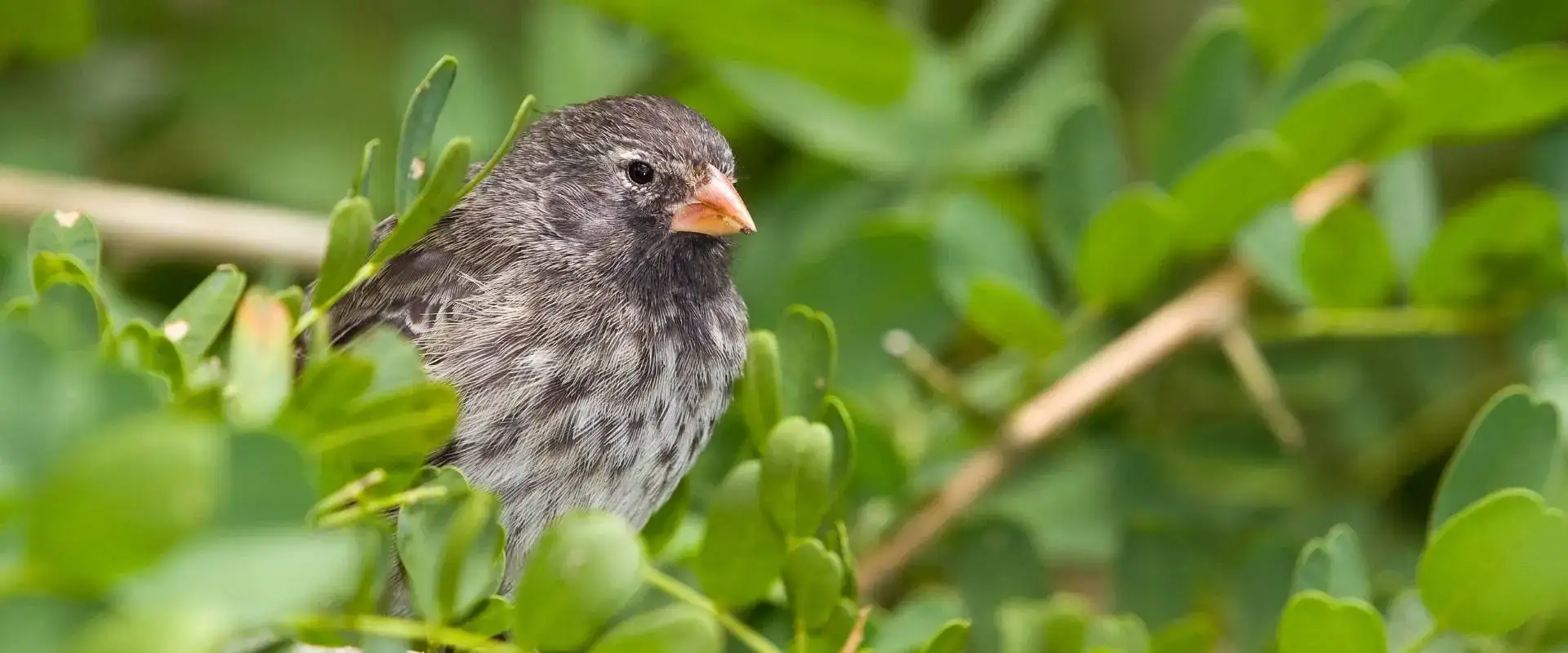
With no predators and extreme isolation, evolution happened fast. Species adapted to specific niches on specific islands. A finch on one island developed a beak perfect for cracking seeds. A finch on another island developed a beak for picking insects off trees. Same ancestors. Different islands. Different beaks. Different species. All in maybe a few million years. Not sure how to fit this into a trip? Tell us your dates and we will map it out.
Tortoises on wet islands grew large. Tortoises on dry islands stayed small. Marine iguanas evolved to eat algae in the ocean while land iguanas stayed inland. Everything diverged. Everything specialized.

Charles Darwin Galapagos: The Moment That Changed Biology
Charles Darwin Galapagos is one of the most famous pairings in science history, but the actual visit lasted only five weeks. Charles Darwin was only 22 years old when he boarded HMS Beagle in December 1831. He was a naturalist (basically a scientist without formal training), about to embark on a 5-year voyage around the world. The Galapagos were just one stop. Darwin spent five weeks aboard the HMS Beagle visiting four specific islands: San Cristóbal, Floreana, Isabela, and Santiago.
The ship arrived in the Galapagos in September 1835 and stayed for 5 weeks. Darwin explored several islands, collected specimens (notably finches that he didn’t think were particularly important at the time), and observed the tortoises and iguanas.
What struck Darwin wasn’t the animals themselves. It was that each island had slightly different versions of similar animals. He started thinking: why? Why would an island have its own specific tortoise? Why would finches vary between islands?
The answer he eventually reached: they’d all descended from common ancestors who’d arrived on the islands, then adapted over time to local conditions. It wasn’t special creation (the prevailing belief). It was modification through time. Evolution.

Darwin’s Finches: The Heart of Evolution
Let me explain why Darwin’s finches matter so much.
When Darwin returned to England, he didn’t immediately realize the finches’ significance. It took years of research and discussion with other scientists before he understood what he’d collected. These weren’t 13 separate species that just happened to be finches. They were 13 varieties of finch, descended from a single ancestor, each adapted to a different food source.
Beak size and shape? Directly related to diet. Island with seeds? Big-beaked finches dominate. Island with insects? Small-beaked finches thrive. This wasn’t random. It was adaptation through competition and survival.
This became the centerpiece of Darwin’s theory of natural selection. The finches proved it: organisms change over time based on environmental pressure. The ones best adapted to their environment survive and breed. The ones less adapted don’t. Over generations, the population shifts.

The Origin of Species (1859): The Game-Changer
Darwin spent 23 years thinking about what he’d observed in the Galapagos before publishing “On the Origin of Species by Means of Natural Selection.” The book didn’t just change biology it changed how humans understood themselves.
Before Darwin, the prevailing belief was that species were created exactly as they appear and never changed. The Galapagos showed otherwise. Species change. They adapt. They branch into new species. Evolution isn’t just a theory it’s observable fact.
Religious institutions freaked out. The idea that humans and animals shared common ancestors? Heretical. But the evidence was undeniable. Science won. And it all started in a remote archipelago 960km off Ecuador.
The Galapagos Floreana Mystery: 1930s Disappearances
The galapagos floreana mystery is the strangest chapter in the history of the Galapagos Islands. In the early 1930s, a group of European settlers arrived on Floreana to escape modern civilization. Dr Friedrich Ritter, the eccentric Baroness Eloise Bosquet, and several others soon vanished or died under suspicious circumstances. Nearly a century later, the case still has no resolution — and it inspired the 2024 film Eden. If you visit Floreana today, the same cliffs and salt flats are still there, mostly unchanged. More on Ecuador travel context here, and our practical Galapagos travel notes if you are planning a visit.
After Darwin: The Forgotten Century of Galapagos History
Most people skip from Darwin to “conservation” and miss 100 years of weird, dark history in between. Here is what actually happened in galapagos islands history after Darwin sailed away. Ecuador ran a penal colony on Floreana and later Isabela for 127 years — the last prisoners were not released until 1959. American writer Herman Melville visited on a whaler in 1841 and called the Galapagos Islands “evilly enchanted,” writing about them in The Encantadas. Ecuador had formally annexed the archipelago on February 12, 1832, sending General José de Villamil as first governor with about 80 settlers — mostly soldiers from a failed coup.
Whalers were brutal: between 1784 and 1860 they killed more than 100,000 giant tortoises for meat and oil, pushing several Galapagos Islands species to extinction. The 1905-06 California Academy of Sciences expedition collected 76,000 specimens — the largest scientific haul in the history of the Galapagos Islands — including the last specimens of species that disappeared right after.
World War II turned Galapagos into a military base. After Pearl Harbor in 1941, the United States built an airbase on Baltra Island to defend the Panama Canal — by 1943 it housed 2,474 American soldiers and 750 civilian workers, the largest population the Galapagos Islands had ever seen. President Franklin D. Roosevelt visited in 1938 aboard the USS Houston.
After the war, the runway became the Galapagos Islands main airport — when you fly in today, you are landing on a WWII military strip. Tuna fishing exploded in the same period: until 1937, up to 70% of all tuna landed in California came from Galapagos waters. Ecuador finally pushed back by claiming a 200-mile territorial water zone in 1950 and banning commercial fishing in 1998. None of this gets told on most tour pages, but it explains why the modern galapagos islands history looks the way it does today.
LOCAL GUIDE AND DRIVER, EVERY DAY
12 Day Ecuador and Galapagos Tour: Andes, Amazon and Island Hopping
The Andes and the Amazon with your own guide and driver from Quito, then a week of island hopping on Santa Cruz and Isabela with a yacht day.
From $2,690 per person
View itineraryThe Modern Galapagos: Conservation & Protection
After centuries of whaling and limited colonization, the Galapagos Islands faced a new threat in the 20th century: large-scale tourism and modern settlement. By the 1960s, scientists realized the unique ecosystem was at risk — too many introduced species, too much pressure on tortoise populations, not enough protection. That is why 1959 mattered: Ecuador declared the archipelago a national park, and the Charles Darwin Foundation was born.
In 1968, Ecuador declared the Galapagos a National Park. In 1978, UNESCO designated it a World Heritage Site. Today, about 96% of the islands are protected parkland. Only specific settled areas allow development.
What’s remarkable is how well conservation is working. Animal populations are stable or recovering. The Charles Darwin Research Station (which I visit regularly) is one of the world’s premier conservation centers. Scientists there study species adaptation and manage breeding programs for endangered animals.

Endemic Species: Life Found Nowhere Else
The isolation that fascinated Darwin is still creating unique species:
| Species | Unique Characteristic | Only Found Where |
| Galapagos Finches | 13+ species, adapted beaks | Galapagos only |
| Marine Iguanas | Only ocean-going lizards | Galapagos only |
| Galapagos Penguins | Northernmost penguin species | Galapagos only |
| Galapagos Giant Tortoises | Live 100-200 years | Galapagos only (now) |
| Flightless Cormorants | Lost ability to fly (unique) | Galapagos only |

How Tourism Changed the Islands
Tourism to the Galapagos exploded after the 1970s, once the national park status opened scheduled flights and regulated visits. Where the 1970s saw only a few thousand visitors per year, today the number is over 200,000 annually — the main reason the islands need strict visitor caps.
This creates obvious threats: introduced species (rats, cats, plants), pollution, overfishing, and simple wear from having thousands of people walking trails daily. But it also creates motivation for conservation. Tourism brings money to Ecuador, creating economic incentive to protect the islands.
Ecuador’s response? Strict rules about what tourists can do and where they can go. Guides are required. Group sizes are limited. Trails have carrying capacity limits. Nobody’s permitted to feed or touch wildlife. These aren’t suggestions—they’re laws enforced by park rangers.
The Charles Darwin Research Station: Still Studying Evolution
If you visit Santa Cruz Island, the Charles Darwin Research Station (formally the Charles Darwin Foundation) is worth a stop. It has been operating since 1959 and is one of the most important conservation centers on Earth.
They’re doing active breeding programs for endangered species. Monitoring population changes. Studying how climate change affects the islands. Breeding giant tortoises that are critically endangered, then releasing the juveniles back to their home islands. It’s not a zoo or tourist attraction—it’s actual science happening. And visitors get to see it and understand why these islands matter so much beyond just “cool wildlife.”

Understanding Evolution Through the Galapagos
When you visit the Galapagos, you’re walking through a living laboratory of evolution. You can see adaptation in action. You can understand why Darwin’s ideas matter. A blue-footed booby’s webbed feet? Adaptation to diving. Marine iguanas’ ability to regulate body temperature? Adaptation to cold ocean water.
This context transforms a vacation into education. You’re not just watching cool animals you’re seeing proof of one of science’s most important theories.

Related Content
- Galapagos Islands Travel Guide: Everything You Need to Know
- Galapagos Snorkeling: Marine Life & Best Spots
- Isabela Island Guide: Wildlife & Activities
- Charles Darwin & the Origin of Species Connection
Who discovered the Galapagos Islands?
The Galapagos Islands were discovered on March 10, 1535, by the Spanish bishop Tomás de Berlanga, who drifted off course while sailing from Panama to Peru. His ship was carried by ocean currents to the islands, making his accidental landing the first known European contact with the archipelago.
How did the Galapagos Islands get their name?
The Galapagos Islands were named after the giant tortoises that lived there. Early Spanish explorers used the word “galápago,” meaning saddle, because the curved shells of the tortoises reminded them of a Spanish saddle. The name first appeared on a map by Mercator in 1569.
When did Charles Darwin visit the Galapagos?
Charles Darwin visited the Galapagos Islands from September 15 to October 20, 1835, during the second voyage of the HMS Beagle. He spent five weeks exploring four islands — San Cristóbal, Floreana, Isabela, and Santiago — and his observations later shaped the theory of evolution published in 1859.
What is the mystery of the Galapagos Islands?
The most famous Galapagos mystery is the Floreana affair of 1934, when several European settlers vanished or died under suspicious circumstances. Dr Friedrich Ritter, the so-called Baroness Eloise Bosquet, and others disappeared without explanation. The case remains unsolved and inspired the 2024 film Eden.
When did Ecuador take ownership of the Galapagos Islands?
Ecuador officially annexed the Galapagos Islands on February 12, 1832, just twelve years after independence from Spain. The first Ecuadorian governor was General José de Villamil, who founded a colony on Floreana with about 80 settlers, mostly former soldiers from a failed coup.
How long have people lived on the Galapagos Islands?
People have lived on the Galapagos Islands for almost 200 years, since the first permanent Ecuadorian settlement in 1832. Before that, Patrick Watkins (Irish, 1805-1809) lived alone on Floreana for four years. Today around 33,000 residents live mostly on Santa Cruz, San Cristóbal, and Isabela.
Visit Where Evolution Was Proven
Standing where Darwin stood, seeing the animals he observed, understanding how they evolved—it’s a perspective-changing experience. Our guides can walk you through the history, show you the research stations, and help you understand why these islands matter to science and conservation.
Looking for more on Galapagos Islands History? Browse our related coverage on galapagos islands history ecuador, galapagos islands history guide, galapagos islands history tour, and reach out to our local experts for personalized planning.
Galapagos Islands History Timeline at a Glance
Quick reference of every year that matters in galapagos islands history, from accidental discovery to modern conservation:
| Year | Event in Galápagos History |
|---|---|
| 1535 | Fray Tomás de Berlanga accidentally discovers the islands |
| 1569 | First appearance on a Mercator world map |
| 1684 | First documented pirate visit — Batchelor’s Delight |
| 1697 | William Dampier publishes account, coining “sea lion” |
| 1793 | James Colnett charts islands for British whaling fleet |
| 1805–09 | Patrick Watkins becomes first known resident, on Floreana |
| 1832 | Ecuador formally annexes the archipelago (Feb 12) |
| 1835 | Charles Darwin visits aboard HMS Beagle (5 weeks) |
| 1841 | Herman Melville visits, later writes The Encantadas |
| 1859 | Darwin publishes On the Origin of Species |
| 1905–06 | California Academy expedition collects 76,000 specimens |
| 1934 | The Floreana mystery — German settlers disappear |
| 1938 | President Franklin D. Roosevelt visits on USS Houston |
| 1941–46 | US WWII airbase on Baltra (2,474 personnel) |
| 1959 | National Park declared; Charles Darwin Foundation founded |
| 1971 | Lonesome George — last Pinta tortoise — discovered |
| 1978 | UNESCO World Heritage Site designation |
| 1998 | Special Law bans commercial fishing in protected waters |
| 2012 | Lonesome George dies; Pinta tortoise extinct |
Before You Go to the Galapagos
If this is your first trip, do not overload the itinerary. Pick one island as your base, plan two day trips, and leave room for the unexpected. The history of the Galapagos Islands took 500 years to unfold — yours does not have to fit in five days. The best moments are usually the unscheduled ones: a sea lion that wants to play, a sunset on Tortuga Bay, a casual conversation with someone who has lived here longer than you have. Today around 33,000 residents live on the islands — mostly on Santa Cruz, San Cristóbal, and Isabela — so the human history of the Galapagos is still very much alive.